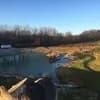
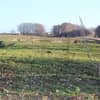
Permakultur-Agroforstfläche mit Wasserretentionsteich
Is jointly established and managed by the Permagold cooperative and the Lausitzer Höfeläden UG. It was planted in cooperation with Thomas Noack from Lausitzer Höfeläden.
Particularly noteworthy is the active role of the Sorbian community Njebjelčicy/Nebelschütz, to which the land belongs and from which the land is leased under a long-term contract. The area is integrated into the Njebjesa/Himmelsort project.
The 'Njebjesa' project builds on the long-standing pioneering work of the municipality of Nebelschütz. As early as 2004, Nebelschütz was a pilot municipality in Saxony for ecological compensation measures. In this way, numerous orchard meadows and Benjes hedges could be established, avenues replanted, an ecological herb garden created, and professional advice financed. The municipality has always valued acquiring land to secure it long-term for consistent ecological development.
»Njebjesa« addresses concrete challenges: The fields on slopes are losing more and more humus due to industrially operated agriculture. Rain and wind cause the fertile soil to erode. The input of pesticides, herbicides, and fertilizers on fields intensively cultivated with monocultures, e.g., corn, is also a cause for concern. The agricultural chemicals harm insects and reduce biodiversity in the field waters. Even in the Jauerbach, no animal life can be seen with the naked eye. The »Njebjesa« project aims to create protected zones that significantly reduce the impact of conventional agriculture on the sensitive area of the Jauerbach.
The special feature of this area is also the integration of a water retention basin, with all the benefits for flood protection, water supply, and a better microclimate.

Agroforestry system type:
Silvoarable system (woody and arable crops incl. intercropped permanent crops)Size of agroforestry system area(s) (in ha):
1.5Percentage of area under trees/shrubs (in %):
30Establishment (date):
Apr 29, 2020Site specifics:
- susceptibility to erosion
- species-poor site
- landscape with few structures / landscaope elements
Farming sectors:
- Arable farming
- Fruit growing
- Wood production
Tree species:
- Apple (Malus domestica)
- Pear (Pyrus communis)
- Sweet Chestnut (Castanea sativa)
- Cherry / Wild Cherry (Prunus avium)
- Plum (Prunus domestica)
- Peach (Prunus persica)
(Intended) use of trees:
- food production (e.g. production fruit/nut)
- environmental benefits (incl. carbon/ windbreaks/ animal welfare/ biodiversity)
- other material use
Shrub species:
- Blackberry (Rubus fruticosus)
- Blueberry/ Cranberries/ Bilberries/ Huckleberries/ Madeira Blueberries (Vaccinium spp.)
- Raspberry (Rubus idaeus)
- Currants (red/ white/ black) (Ribes spp.)
(Intended) use of the shrubs:
- food production (e.g. production fruit / nut)
- environmental benefits (incl. carbon/ windbreaks/ animal welfare/ biodiversity)
- other material use
Main crop types in the agroforestry system:
- vegetables
Motivation/rationale for establishing or maintaining agroforestry system:
- establish ecological balance
- Erosion protection
- Reduce nutrient input into surface waters
- Diversified product range
- Contribution to climate protection / resilience