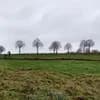
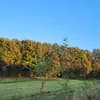
sukzessionales Keyline Agroforstsystem - Anordnung nach Masterline Prinzipien; Maronen und Walnüsse mit schnellwachsenden Bäumen, dazwischen kleinere Obst- und Beerentragende Bäume und Sträucher mit Blumen und Kräutern
The inspiration for the system comes from Marc Shepard, Yeomans, and the syntropic/dynamic approach.
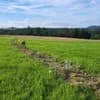
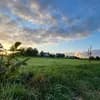
This silvopastoral agroforestry system is located at the upper part of a slope descending to the northeast. There is a wet area on the site, which is mostly impassable for 9 months of the year. The rest of the area is highly susceptible to drought. Therefore, the diagonal arrangement of the tree strips on this relatively rectangular area arises. With a slope between 0.5 and 1.5%, all tree rows, where earth has been dug out longitudinally, are designed to balance this wet-drought gradient and to ensure good water availability along the tree rows.
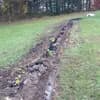
Already during the 2021 installation, a noticeable water flow could be observed when digging the Masterline swales. Since then, this measure alone has increased the productivity of the site within the hydrological area structure by between 30 and 60%, depending on the calculation year.
The grassland site is cut twice a year (1st hay & 2nd silage) and chickens are kept in a mobile coop. They also have access to the tree strips.
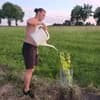
The tree stock consists of walnut seedlings, sweet chestnut seedlings, hybrid poplars, various shrub fruit varieties, and other trees and shrubs.
For the planting, 2 m³ of biochar was applied.
Agroforestry system type:
Silvopastoral system (woody and livestock incl. grazed permanet crops)Size of agroforestry system area(s) (in ha):
1.1Percentage of area under trees/shrubs (in %):
13.636Establishment (date):
Nov 11, 2021Site specifics:
- drought / low water holding capacity
- low soil fertility
- susceptibility to erosion
Farming sectors:
- Arable farming
- Fodder production
- Livestock farming
- Wood production
Tree species:
- Maple (Acer spp.)
- Sweet Chestnut (Castanea sativa)
- Poplar (Populus spp.)
- Plum (Prunus domestica)
- European Crab Apple (Malus sylvestris)
- Paulownia (Paulownia tomentosa)
- English / Persian Walnut (Juglans regia)
- White Mulberry (Morus alba)
- Black Mulberry (Morus nigra)
(Intended) use of trees:
- production biofuel wood
- production stemwood
- food production (e.g. production fruit/nut)
- environmental benefits (incl. carbon/ windbreaks/ animal welfare/ biodiversity)
- other material use
Shrub species:
- Juneberry (Amelanchier lamarckii)
- Black Elderberry (Sambucus nigra)
- Paw Paw (Asimina triloba)
(Intended) use of the shrubs:
- food production (e.g. production fruit / nut)
- environmental benefits (incl. carbon/ windbreaks/ animal welfare/ biodiversity)
Livestock species in the agroforestry system:
- poultry
Other agroforestry products:
- ökologische Effekte durch Optimierung des Wasserhaushalts mit minimalem Eingriff
Motivation/rationale for establishing or maintaining agroforestry system:
- establish ecological balance
- Higher productivity
- Erosion protection
- Diversified product range
- Contribution to climate protection / resilience