Silvoarables Wertholzsystem mit Pappelstreifen auf Gut Marienhof
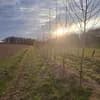
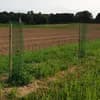
In Hückelhoven, several rows of young valuable trees were established in March 2025 on a six-hectare slope area. A total of around 350 trees were planted - including hazel, hybrid walnut, silver maple, wild cherry, and cider pear. The trees were planted in groups of three and will be selectively thinned in the coming years to optimize growth. The woody plants are distributed on five parallel strips with a total woodland area of 0.9 hectares. Two years ago, a first poplar strip (0.15 ha) was already planted. Arable farming is practiced between the strips of woody plants.
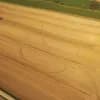
A challenge on the farm is the slope: Heavy rainwater leads to soil erosion here. To counteract this process, strips of trees and shrubs were laid out across the slope. These are intended to efficiently channel the rainwater into the soil and preserve fertile agricultural soil in the long term.
The project is funded by the VRD Foundation for Renewable Energies and the Eva Mayr-Stihl Foundation. A central goal is the research of sustainable agroforestry and the economic potential of valuable woods.
Agroforestry system type:
Silvoarable system (woody and arable crops incl. intercropped permanent crops)Size of agroforestry system area(s) (in ha):
6Percentage of area under trees/shrubs (in %):
15Establishment (date):
Mar 13, 2025Site specifics:
- susceptibility to erosion
Farming sectors:
- Arable farming
- Fodder production
- Livestock farming
- Energy production
Tree species:
- Poplar (Populus spp.)
- Hybrid Walnut / Intermediate (Juglans hybride / intermedia)
- Turkish Hazel (Corylus colurna)
- Norway Maple (Acer platanoides)
- Cherry / Wild Cherry (Prunus avium)
- Pear (Pyrus communis)
(Intended) use of trees:
- production stemwood
Motivation/rationale for establishing or maintaining agroforestry system:
- establish ecological balance
- Erosion protection
- Contribution to climate protection / resilience