Leuchtturmprojekt Werragut - 12 ha silvoarables & silvopastorales Agroforstsystem nach Keylinedesign + syntropisches Agroforstsystem
To bring agroforestry into wider practice, lighthouse projects are needed that make this form of sustainable land management tangible and in this way invite imitation.
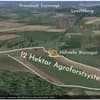
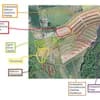
We launched such a lighthouse project on 12 hectares as the association "Regenerative and Social Agriculture e.V." in 2022: Through crowdfunding, financial resources were raised to fund the first 1,200 trees and shrubs. The tree rows are aligned with the contour lines (keyline design) so that as much rainwater as possible can be retained on the slope. Chickens graze under the trees in mobile chicken coops, and in the future, Harzer Red Cattle may also graze there. On the arable land, crops such as cereals, buckwheat, hemp, clover grass, etc. are cultivated without plowing.
As a "teaching and learning project," we want to show what climate change-adapted agriculture can look like: We plant over 15 different species, from walnut to chestnut to fig – and combine this with mobile chicken husbandry and arable farming. In addition, we test promising substrates such as biochar and mycorrhizal fungi. As a practical research farm, we cooperate with the University of Kassel.
Other essential elements of the project include community-supported ecological-regenerative land use combined with practical research and education, as well as the integration of people with disabilities. The project is led by the agroforestry planning office "TRIEBWERK" from Witzenhausen in cooperation with the Bioland farm Werragut.
Press reports:
- SAT.1 Regionalmagazin 24.03.2022: https://www.1730live.de/agroforst-nachhaltigkeit-auf-dem-acker/
- HNA-Bericht Pflanzaktion 17.03.2022 https://www.hna.de/lokales/witzenhausen/ersten-300-baeume-und-straeucher-des-agroforstprojekts-sind-gepflanzt-91417361.html
- Hessenschau-Beitrag 07.12.2021: https://www.hessenschau.de/wirtschaft/fit-fuer-den-klimawandel-kakis-feigen-und-pawpaw-aus-nordhessen,agroforst-neue-landwirtschaft-102.html
Agroforestry system type:
Agrosilvopastoral system (woody plants/ arable crops and livestock)Size of agroforestry system area(s) (in ha):
12Percentage of area under trees/shrubs (in %):
5Establishment (date):
Feb 28, 2022Site specifics:
- low soil fertility
- susceptibility to erosion
Farming sectors:
- Arable farming
- Livestock farming
- Energy production
Tree species:
- Apple (Malus domestica)
- Pear (Pyrus communis)
- Alder (Alnus spp.)
- Ash (Fraxinus spp.)
- Sweet Chestnut (Castanea sativa)
- Poplar (Populus spp.)
- Willow (Salix spp.)
- Common Fig (Ficus carica)
- Persimmon (Diospyros kaki)
- English / Persian Walnut (Juglans regia)
(Intended) use of trees:
- food production (e.g. production fruit/nut)
- environmental benefits (incl. carbon/ windbreaks/ animal welfare/ biodiversity)
Shrub species:
- Hazelnut (Corylus avellana)
- Juneberry (Amelanchier lamarckii)
- Dogwood (Cornus spp.)
- Raspberry (Rubus idaeus)
- Black Elderberry (Sambucus nigra)
- Cornelian Cherry (Cornus mas)
- Silverberry (Elaeagnus commutata)
(Intended) use of the shrubs:
- food production (e.g. production fruit / nut)
- environmental benefits (incl. carbon/ windbreaks/ animal welfare/ biodiversity)
Livestock species in the agroforestry system:
- poultry
- cattle
Main crop types in the agroforestry system:
- field grass
- lucerne
Motivation/rationale for establishing or maintaining agroforestry system:
- establish ecological balance
- Higher productivity
- Erosion protection
- Reduce nutrient input into surface waters
- Diversified product range
- Contribution to climate protection / resilience
- Protective effect for livestock
- Landscape / aesthetics