Lehr- und Versuchsbetrieb Gladbacherhof (3. Agroforstsystem)
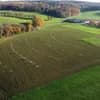
The Hessian state domain Gladbacherhof has been managed according to Bioland guidelines since 1981 and has been a teaching and experimental farm of the Justus Liebig University Giessen since 1990. In November 2022, six rows of trees, each 4 m wide (a total of 770 m), were established on a 3.1 ha arable field. Between them are 18 m wide strips of arable land, which are managed according to Gladbacherhof’s eight-year crop rotation. In two rows, there are only apple trees (4 different varieties) planted at a distance of 12 m. In two other rows, valuable wood trees and elderberry bushes were additionally planted between the apple trees. In spring 2023, the spaces in between will be planted with poplar cuttings at 1 m intervals and rhubarb will be set as an early yield component. Two other rows differ from the latter only in that the valuable wood trees here are not planted but sown by direct seeding.
Agroforestry system type:
Silvoarable system (woody and arable crops incl. intercropped permanent crops)Size of agroforestry system area(s) (in ha):
3.1Percentage of area under trees/shrubs (in %):
9.677Establishment (date):
Nov 21, 2022Site specifics:
- susceptibility to erosion
Farming sectors:
- Arable farming
- Fodder production
- Livestock farming
Tree species:
- Apple (Malus domestica)
- Wild Service Tree (Sorbus torminalis / Torminalis glaberrima)
- Cherry / Wild Cherry (Prunus avium)
- Poplar (Populus spp.)
- Service Tree (Cormus domestica)
- English / Persian Walnut (Juglans regia)
(Intended) use of trees:
- production stemwood
- food production (e.g. production fruit/nut)
- environmental benefits (incl. carbon/ windbreaks/ animal welfare/ biodiversity)
Shrub species:
- Black Elderberry (Sambucus nigra)
(Intended) use of the shrubs:
- food production (e.g. production fruit / nut)
- environmental benefits (incl. carbon/ windbreaks/ animal welfare/ biodiversity)
Main crop types in the agroforestry system:
- field beans
- field grass
- oats
- potatoes
- lucerne
- corn / maize
- common wheat
Other agroforestry products:
- Rhabarber
Motivation/rationale for establishing or maintaining agroforestry system:
- establish ecological balance
- Higher productivity
- Erosion protection
- Reduce nutrient input into surface waters
- Contribution to climate protection / resilience
- Landscape / aesthetics